
Healthy Weight and Waist
No Hypertension
No Diabetes
No Chronic Kidney Disease
No Cardiovascular Disease
Last update: June 27th, 2026.
Recent research published in JAMA (2024) analyzed data from over 10,000 adults using the National Health and Nutrition Examination Survey (NHANES). The findings were staggering:
For individuals with type 2 diabetes, these figures represent a critical inflection point. Diabetes is not merely a metabolic disorder —it is the gateway to a systemic cascade that engulfs the heart and kidneys—. Many patients classified as CKM stage 1 or 2 are entirely asymptomatic, yet their biomarkers already tell a story of progressive, measurable deterioration.
While conventional medicine often treats the heart, kidneys, and metabolic system as isolated entities, emerging evidence reveals a profound biological interdependence. Cardiovascular-Kidney-Metabolic (CKM) syndrome represents a paradigm shift in our understanding of how these three core systems influence, amplify, and ultimately determine one another's fate.
By recognizing CKM syndrome as a unified pathophysiological spectrum rather than three separate diseases, we empower clinicians and patients to intervene earlier, target multiple pathways simultaneously, and transform reactive treatment into proactive prevention.
For decades, the conventional healthcare model has addressed cardiovascular disease, chronic kidney disease, and metabolic disorders —primarily type 2 diabetes— as distinct clinical silos. Standard laboratory testing typically delivers fragmented data: a lipid panel here, a creatinine value there, an HbA1c in isolation —metrics that offer minimal insight into the dynamic, bidirectional relationships that drive systemic deterioration—.
At Blueberry Diagnostics, we firmly believe that true prevention only begins when fragmented data is synthesized into a coherent physiological narrative. CKM syndrome demands an integrative diagnostic approach that captures the simultaneous interplay of cardiac strain, renal filtration capacity, and metabolic dysregulation —long before any single organ reaches a critical threshold—.

Chronic hyperinsulinemia, advanced glycation end-products (AGEs), and tissue hypoxia —driven by microvascular strain—, act as systemic drivers. They don't just accelerate target-organ damage; they permanently alter the cellular microenvironment.
This continuous physiological stress fuels angiogenesis, damages cellular DNA repair mechanisms, and turns a declining metabolic profile into an ideal catalyst for malignant cell survival and proliferation.
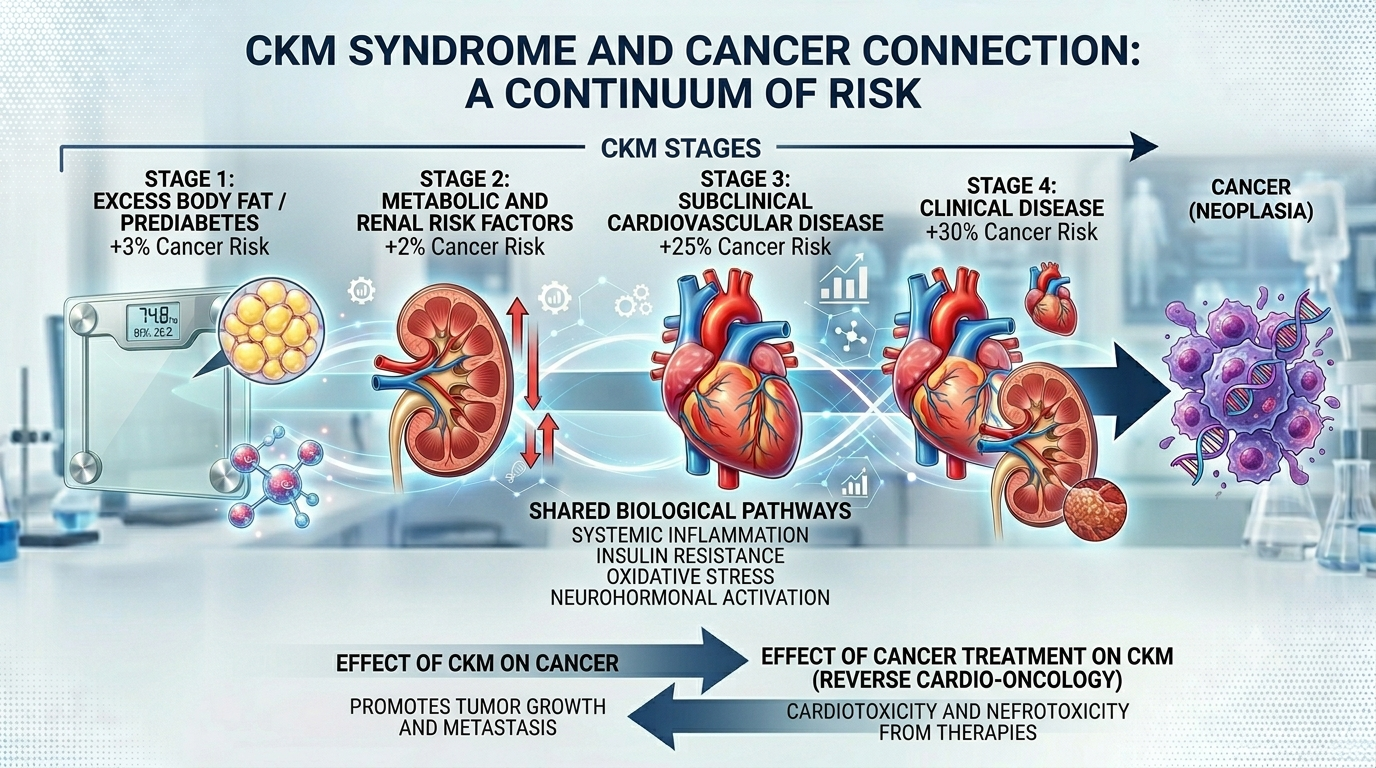
In fact, since cancer risk increases steadily —between 25% and 30%— as CKM progresses to stages 3 and 4, the early detection of CKM plays a crucial role in cancer prevention.
The metabolic, renal, and cardiovascular dysregulations that define CKM syndrome do not exist in isolation; they create a highly fertile, pro-inflammatory systemic environment that actively lowers the body's threshold for oncological development and tumor progression.
Chronic hyperinsulinemia, advanced glycation end-products (AGEs), and tissue hypoxia driven by microvascular strain act as systemic drivers. They don't just accelerate target-organ damage; they permanently alter the cellular microenvironment. This continuous physiological stress fuels angiogenesis, damages cellular DNA repair mechanisms, and turns a declining metabolic profile into an ideal catalyst for malignant cell survival and proliferation.
Consequently, monitoring the CKM timeline is no longer just about preventing cardiovascular events—it is a critical window for comprehensive, early oncological interception.
Therefore, transitioning to a high-precision, data-driven preventive model is essential to intercept these risk vectors early, ensuring that extended lifespan is seamlessly paired with a vibrant, disease-free health span.
CKM syndrome does not manifest overnight. Like many chronic conditions, it advances through distinct stages, with physiological damage accumulating silently until symptoms become undeniable. That is precisely why early detection is so critical since the preclinical window offers the greatest opportunity for reversible intervention.
Healthy Weight and Waist
No Hypertension
No Diabetes
No Chronic Kidney Disease
No Cardiovascular Disease
Overweight and Obesity
Abdominal Adiposity
Without Other Metabolic Factors
Hypertension
Dyslipidemia
Type 2 Diabetes Mellitus
Moderate-Risk Chronic Kidney Disease
Subclinical Cardiovascular Disease
Atherosclerosis
High-Risk Chronic Kidney Disease
Albuminuria
Cardiovascular Disease
Endothelial Disease
Heart Failure
Myocardial Infarction
Stroke
High-Risk Chronic Kidney Disease
Optimal metabolic, cardiovascular, and renal biomarkers: The ideal baseline for longitudinal monitoring and prevention.
Excess adiposity, prediabetes, or early dyslipidemia without end-organ damage: Subtle metabolic shifts detectable through advanced screening panels. In addition, there is an ~3% increase in the risk of developing cancer.
Type 2 diabetes, hypertension, or chronic kidney disease (CKD stage 1-2) with subclinical cardiovascular changes: Biomarker panels reveal cross-system stress patterns. In addition, there is an ~2% increase in the risk of developing cancer.
Established atherosclerotic cardiovascular disease, CKD stage 3+, or symptomatic heart failure: Requires intensive, coordinated multidisciplinary intervention. In addition, there is an ~25% increase in the risk of developing cancer.
Cardiovascular events, kidney failure requiring replacement therapy, or severe metabolic decompensation: The costliest stage —both clinically and economically—. In addition, there is an ~30% increase in the risk of developing cancer.
We move beyond isolated metrics. Our preventive panels simultaneously evaluate cardiovascular biomarkers (sterols and fatty acids), renal function (creatinine, eGFR, albuminuria and electrolytes), and metabolic status (hepatic enzymes, glucose, HbA1c and insulin resistance indices) —generating a unified risk profile rather than fragmented data points—.
CKM syndrome develops silently. Our advanced screening methodologies detect subclinical inflammation, endothelial dysfunction, and early glomerular hyperfiltration —signals that precede symptomatic disease by years, offering a priceless window for targeted intervention—.
Raw laboratory numbers obscure the bigger picture. Our interpretative reports translate complex biomarker interrelationships into clear, visual trend analyses —enabling both clinicians and patients to grasp systemic risk at a glance and coordinate care across cardiology, nephrology, and endocrinology—.
Early diagnosis requires a deliberate, comprehensive testing strategy. The following biomarkers form the cornerstone of CKM risk stratification:
The heart, kidneys, and metabolism are not separate battlegrounds —they are a single, interconnected system—. Take control of your healthspan through preventive laboratory medicine that reveals hidden cross-system risks before they become irreversible clinical events.
Although the relationship between hypertension, diabetes, and gout was already being discussed in the 1920s, the true father of modern Metabolic Syndrome was the physician Gerald Reaven. In 1988, during a famous lecture, he described "Syndrome X", postulating that insulin resistance was the hidden engine linking hypertension, dyslipidemia (high cholesterol and triglycerides), and glucose intolerance.
Over the years, the name changed to Metabolic Syndrome (MetS) and it became a static checklist: if 3 out of 5 criteria were met (abdominal obesity, high triglycerides, low HDL, high blood pressure, or high glucose), it was considered positive for Metabolic Syndrome.
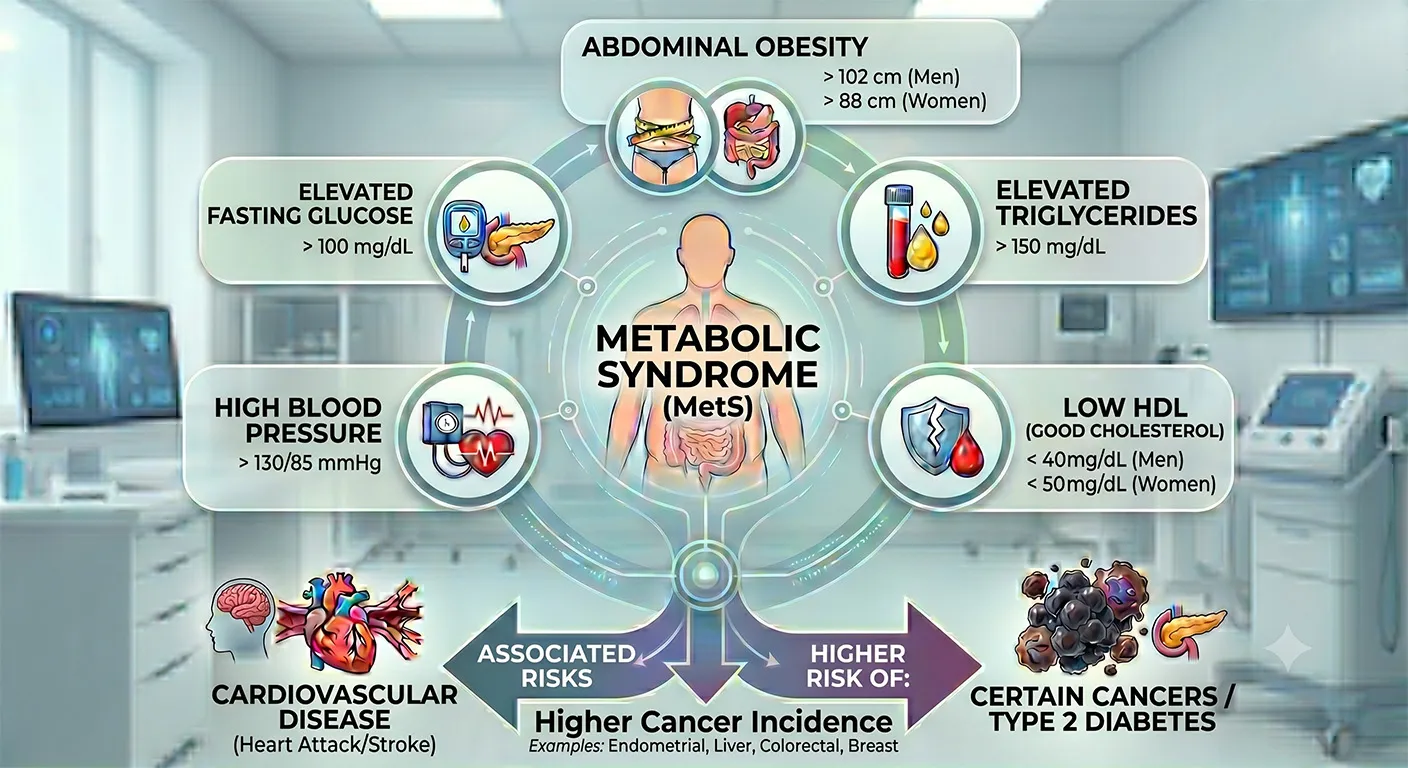
In this regard, in October 2023, the American Heart Association (AHA) coined the new concept of Cardiovascular-Kidney-Metabolic (CKM) Syndrome, realizing that treating the heart on one hand, the kidneys on another, and obesity/diabetes on another was a metabolic mistake.