
Our Evidence
Last update: June 27th, 2026.
Upholding the Highest Standards: Evidence-Based Medicine (EBM) and Evidence-Based Laboratory Medicine (EBLM)
At Blueberry Diagnostics, our foundational commitment is rooted in the strict advancement of Evidence-Based Medicine (EBM) and Evidence-Based Laboratory Medicine (EBLM).
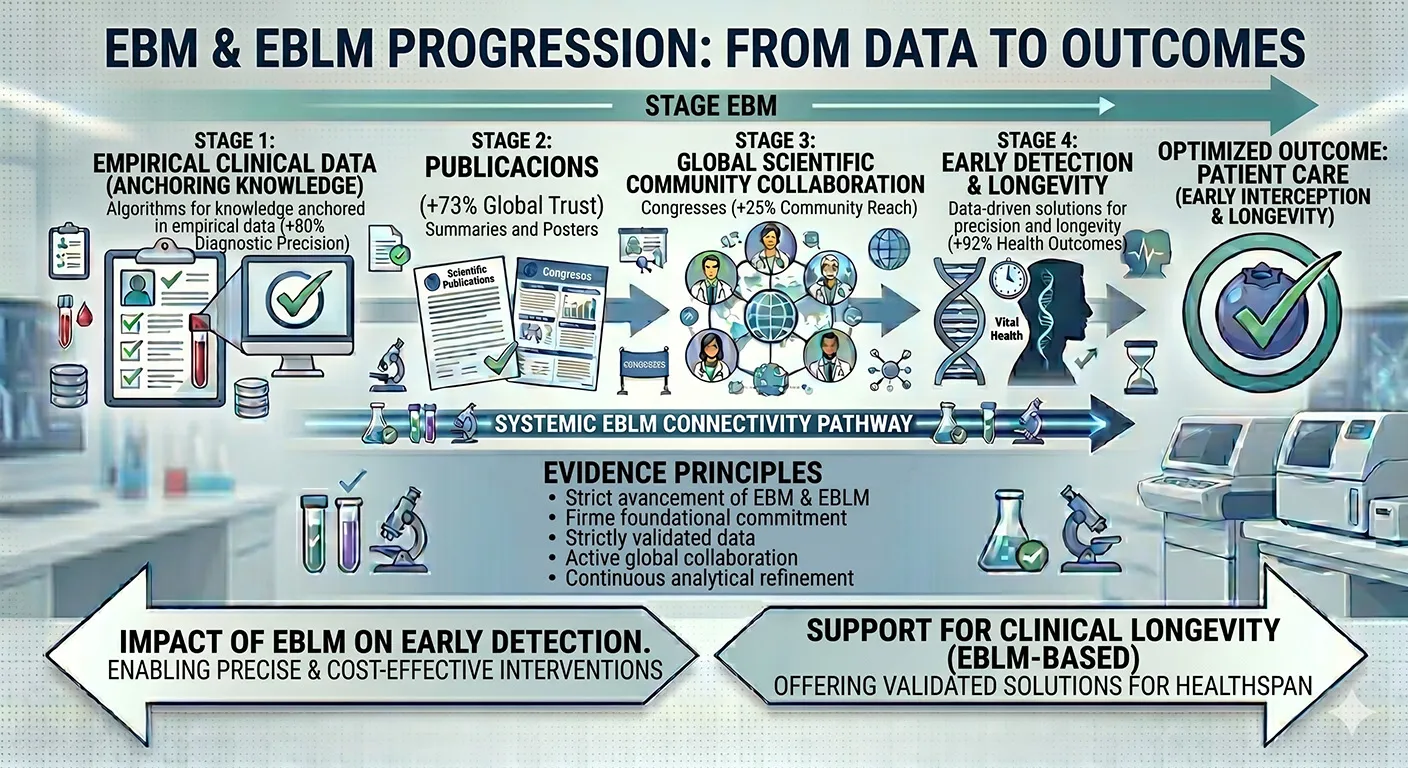
We ensure that every diagnostic algorithm and analytical insight we deliver is anchored in empirical, verifiable clinical data.
Clinical Trials
Clinical trials are research studies performed in people that are aimed at evaluating a medical, surgical, or behavioral intervention, involving an ethics committee and informed consent from patients, to ensure the medical rigor of the process. They are the primary way that researchers discover new treatments for diseases, as well as new ways to detect, diagnose, and reduce the chance of developing the disease.
At Blueberry Diagnostics, we base our clinical trials in case-control studies, that consists in comparing the frequency of exposure in a group of subjects having the studied disease (cases) relative to another group free of that disease (controls).
Presented Evidence
So far, we have presented the results of several of our own studies —in the form of abstracts and posters—, at some of the most important congresses and conferences worldwide.
Presented Evidence related to Health Checkups for Screening and Prevention
Basic Health Checkup for Screening and Prevention
Background & Objective: To develop a novel non-invasive, evidence-based laboratory medicine (EBLM) test to assist doctors in assessing the main body functions, systems and metabolisms, and to evaluate its accuracy in detecting the main non-malignant, highly prevalent, morbid, cancer-precursor, and deadly diseases.
Comprehensive Health Checkup for Screening and Prevention
Background & Objective: To develop a comprehensive non-invasive evidence-based laboratory medicine (EBLM) test to assist doctors in assessing the most body functions, systems and metabolisms, and to evaluate its accuracy in detecting the main non-malignant and malignant, highly prevalent, morbid, cancer-precursor, and deadly diseases.
Presented Evidence related to Health Checkups for Screening and Prevention in different Body Systems and Functions
Iron Transport & Storage Function
Background & Objective: To develop a new non-invasive evidence-based laboratory medicine (EBLM) test to help doctors assess the iron transport and storage function, and evaluate its accuracy in detecting the main types of anemia (normocytic, microcytic, macrocytic), their main causes (liver disease, vitamin B12 deficiency, hemorrhage, or chronic kidney disease), and other hematological disorders.
Cardiovascular Function
Background & Objective: To develop a new non-invasive evidence-based laboratory medicine (EBLM) test to help doctors assess cardiovascular function and evaluate its accuracy in detecting the main cardiovascular diseases (CVD), as well as the 10-year risk of developing them.
Pancreatic Endocrine Function
Background & Objective: To develop a new evidence-based laboratory medicine (EBLM) test to help doctors assess pancreatic endocrine function and evaluate its accuracy in detecting the main pancreatic endocrine diseases and disorders, including insulin resistance, prediabetes, and type 2 diabetes mellitus, among others.
Thyroid Function
Background & Objective: To develop a new evidence-based laboratory medicine (EBLM) test to help doctors assess thyroid function and evaluate its accuracy in detecting the main thyroid diseases, including hypothyroidism, subclinical hypothyroidism, hyperthyroidism, and Graves' disease, among others.
Parathyroid Function
Background & Objective: To develop a new evidence-based laboratory medicine (EBLM) test to help doctors assess parathyroid function and bone metabolism, and evaluate its accuracy in detecting the main parathyroid diseases, including primary hyperparathyroidism, secondary hyperparathyroidism, and hypoparathyroidism, among others.
Hepatobiliary Function
Background & Objective: To develop a new evidence-based laboratory medicine (EBLM) test to help doctors assess hepatic and biliary-pancreatic exocrine function and evaluate its accuracy in detecting the main liver and biliary diseases, including chronic liver disease, steatosis, hepatitis, cirrhosis, and biliary tract disorders, among others.
Renal Function
Background & Objective: To develop a new non-invasive evidence-based laboratory medicine (EBLM) test to help doctors assess renal function and evaluate its accuracy in detecting the main chronic kidney disease (CKD) stages and related disorders.
Hydroelectrolytic Metabolism
Background & Objective: To develop a new non-invasive evidence-based laboratory medicine (EBLM) test to help doctors assess hydroelectrolytic metabolism and evaluate its accuracy in detecting electrolyte imbalances and related disorders.
Prostate Function
Background & Objective: To develop a new non-invasive evidence-based laboratory medicine (EBLM) test to help doctors assess prostate function and evaluate its accuracy in detecting the main prostate disorders, including benign prostatic hyperplasia, prostatitis, and other prostate pathologies.
Presented Evidence related to Cancer Screening
Breast Cancer Screening
Background & Objective: Despite the various methods available for early breast cancer detection (mainly mammography for women between 50 and 65 years old) and their proven benefits, the morbidity and mortality from this neoplasm remain high, partly due to technical limitations and low adherence to screening programs. The objective of the present study was to evaluate diagnostic accuracy for early breast cancer detection using a modeling algorithm based on multiple blood and urine biomarkers.
Colorectal Cancer Screening
Background & Objective: Despite the various methods available for early colorectal cancer (CRC) detection and their proven benefits, the morbidity and mortality associated with this neoplasm remain high, partly due to technical limitations and low adherence to screening programs. In this sense, the objective of the present study was to evaluate diagnostic accuracy for early CRC detection using a modeling algorithm based on multiple blood and urine biomarkers.
Liver Cancer Screening
Background & Objective: Hepatocellular carcinoma (HCC) represents 75% to 85% of malignant liver neoplasms and is the third leading cause of cancer-related mortality worldwide. Unfortunately, HCC typically presents in advanced stages, which poses significant challenges for its treatment and management.
Ovarian Cancer Screening
Background & Objective: Ovarian cancer ranks seventh among female cancers and eighth in cancer-related deaths in women. Despite its low incidence, its impact is considerable due to late detection and limited treatment options. Known as the "silent killer" for its nonspecific symptoms, it often leads to late diagnosis and metastasis. Therefore, early detection remains a challenge.
Prostate Cancer Screening
Background & Objective: Prostate cancer (PC) is the fourth most common cancer type in the world and the second most frequent in men, according to the World Cancer Research (WCRF) Foundation International.
MCED Screening Checkup
Background & Objective: To develop a comprehensive non-invasive evidence-based laboratory medicine (EBLM) test to help doctors screen for multiple cancer types and hundreds of benign diseases simultaneously.
Presented Evidence related to Cancer Confirmation Diagnostics
Colorectal Cancer Confirmation
Background & Objective: Despite the various methods available for early colorectal cancer (CRC) detection and their proven benefits, the morbidity and mortality associated with this neoplasm remain high, partly due to technical limitations and low adherence to screening programs. In this sense, the objective of the present study was to evaluate diagnostic accuracy for early CRC detection using a modeling algorithm based on multiple blood and urine biomarkers.
Lung Cancer Confirmation
Background & Objective: This malignant neoplasm is a global health problem, with high incidence, mortality, and profound socioeconomic impact due to invasive and costly diagnostic procedures. Therefore, a new non-invasive test is needed to provide confirmatory diagnosis of lung cancer. Based on this need, the objective of this study was to conduct a comprehensive meta-analysis to systematically evaluate the estimated diagnostic accuracy of our developed biomarker algorithm for confirming or ruling out lung cancer.